

Think any agent with a shiny headshot can sell your Atlanta home fast?
Not true.
Atlanta is dozens of markets — Buckhead buyers are different from East Atlanta or Decatur buyers — and that changes pricing and marketing.
To sell quickly you need an agent who knows your micro-market, proves recent fast sales and strong list-to-sale results, and brings a written marketing plan plus fast communication.
This guide shows what to ask, which numbers matter, and how to spot real selling results.
Key Criteria for Selecting the Right Atlanta Listing Agent

Atlanta’s real estate market isn’t one market. It’s dozens. A house in Buckhead pulls completely different buyers than a townhome in East Atlanta or a ranch in Decatur. Different price expectations, different marketing angles. That’s why your agent’s neighborhood knowledge matters more than their brand or how polished their business card looks. An agent who actually understands your micro-market can price it right, find the buyers who care, and get you to closing faster.
Past performance tells you what actually happens when they work. Ask for their list-to-sale price ratio on homes like yours. You want 97 to 101 percent or better in well-priced Atlanta neighborhoods. Ask about average days on market. Fifteen to sixty days is normal depending on price and season. And ask how many listings they’ve sold in your ZIP code or neighborhood in the last year. Those aren’t talking points. They’re proof of pricing skill and real market activity.
Communication and marketing execution either work or they don’t. An agent who takes three days to respond during interviews won’t magically get faster once you’ve signed. A vague promise about “maximum exposure” means nothing without a written marketing plan that spells out professional photos, MLS syndication, digital ads, and outreach to buyer’s agents. And references from recent sellers will tell you whether the agent did what they said or left clients scrambling.
Six things to do before you hire:
- Get a list of properties they’ve sold in your neighborhood in the past year. Addresses and final prices.
- Ask for their average list-to-sale ratio and average days on market for those sales.
- Check their Georgia real estate license status using the Georgia Real Estate Commission online lookup.
- Request a written marketing plan and a sample comparative market analysis for your property.
- Read recent reviews on Zillow, Realtor.com, and Google. Focus on the past 12 to 24 months.
- Call at least two seller references. Ask about communication frequency, marketing quality, and final results.
How to Evaluate an Atlanta Listing Agent’s Local Expertise

You can’t verify local expertise by asking if they “know” your neighborhood. Everyone says yes. Instead, ask them to walk you through recent comp sales within a mile of your property that closed in the past six months. Listen for specifics. Street names. Buyer demographics. What features got higher offers. What conditions slowed things down. An agent with real micro-market knowledge will mention details like proximity to the Virginia-Highland Beltline entrance, Decatur school zone interest, or how MARTA access on the east side of Midtown changes pricing.
Throw scenario questions at them. “If we price at $425,000 instead of $440,000, what buyer segment does that open up, and how does it change days on market?” Or: “What time of year do we see the most buyer activity for homes like mine in Old Fourth Ward, and why?” The answer should reference local seasonal patterns, transit access, commute trade-offs, HOA stuff, or flood zone concerns if your property sits near a creek. Vague answers or generic real estate advice are red flags.
Four ways to check local expertise before signing:
- Get a customized comparative market analysis with at least three recent sales in your ZIP code, neighborhood boundaries, and similar square footage.
- Ask them to name the top two buyer objections they hear for homes in your area and how they handle those in marketing.
- See if they know your property’s school district, flood zone status, and HOA rules without needing to look it up during the meeting.
- Check their recent closed transactions on MLS or public records. Make sure they’ve actually sold homes in your micro-market, not just nearby ZIP codes.
Evaluating an Atlanta Listing Agent’s Sales History and Performance Metrics

An agent’s sales history is the clearest predictor of what you’re going to get. Ask for a written summary of homes they’ve listed and sold in your neighborhood or ZIP code over the past year. If they can’t give you at least five to twenty transactions in active neighborhoods (fewer is fine in low-inventory micro-markets), that’s a signal they’re still building local presence. Compare their average days on market to neighborhood benchmarks. Well-marketed homes in Inman Park or Buckhead typically sell within 30 to 45 days during peak season. Homes in outer suburbs may take 45 to 60.
List-to-sale price ratio is the single best measure of pricing accuracy and negotiation skill. A strong Atlanta listing agent should consistently hit 98 to 101 percent of asking, especially in high-demand intown neighborhoods. If the ratio’s below 95 percent, ask why. Could signal overpricing, weak marketing, or poor negotiation. Ask them to show you at least three comp sales they used to price similar homes. Addresses, list prices, final sale prices, and days on market. If they can’t produce that level of detail on the spot or within 24 hours, keep interviewing.
Volume in your specific neighborhood matters more than citywide volume. An agent who sells fifty homes a year across Metro Atlanta but only two in your ZIP code doesn’t have the buyer network or pricing insight you need. Ask how many active buyers they currently represent who are searching in your area. And ask what marketing channels bring those buyers to their listings.
| Metric | What It Shows | What to Ask For |
|---|---|---|
| List-to-Sale Price Ratio | Pricing accuracy and negotiation skill | Average ratio for last 12 months in your neighborhood; expect 97–101% |
| Average Days on Market (DOM) | Marketing effectiveness and buyer reach | DOM for similar homes in your ZIP code; typical range 15–60 days depending on season |
| Sales Volume in Your ZIP Code | Local market activity and buyer network | Number of listings sold in your neighborhood in past 12 months; expect 5–20 in active areas |
| Comparative Market Analysis (CMA) Detail | Depth of pricing research and local knowledge | Written CMA with at least 3 comparable sales within 1 mile and 6 months |
Comparing Full-Service, Discount, and Flat-Fee Atlanta Listing Agents
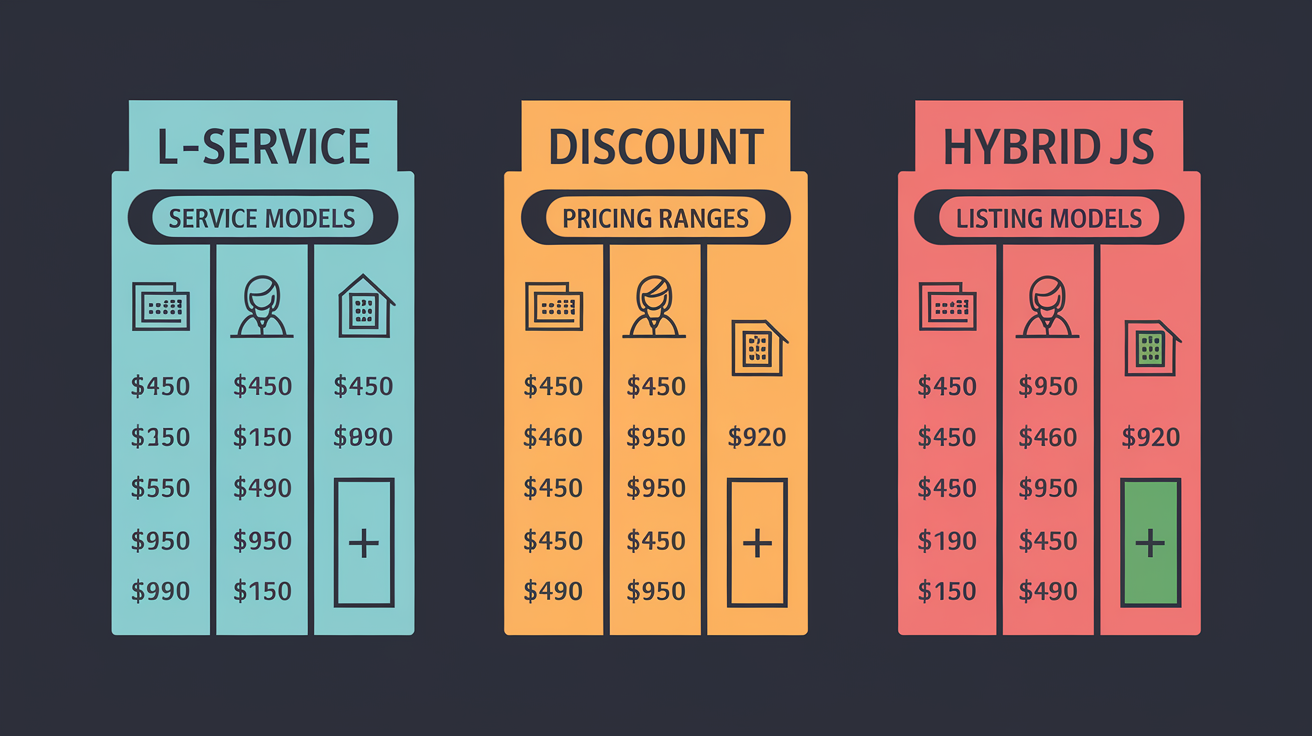
Most full-service Atlanta listing agents charge between 5 and 6 percent total commission, split roughly evenly between the listing broker and the buyer’s agent. On a $400,000 sale, 6 percent commission equals $24,000. That fee usually covers MLS listing, professional photography (around $200 to $600), staging consultation or partial staging ($500 to $5,000 depending on scope), digital advertising ($200 to $2,000 for targeted Facebook, Instagram, or Google campaigns), open houses, and active negotiation support through closing. Full-service agents absorb most marketing costs upfront and coordinate everything from photos to contract management.
Discount or flat-fee agents charge lower commissions. Often 1 to 3 percent for the listing side or a flat fee between $1,500 and $6,000. In exchange, you handle more of the process yourself. Scheduling photographers. Managing showings. Responding to buyer inquiries. Many flat-fee models still offer MLS syndication but reduce or eliminate paid advertising, staging support, and hands-on negotiation. The financial savings are real. You might save $4,000 to $10,000 on a $400,000 sale. But the trade-off is reduced marketing exposure and often longer days on market. Buyers’ agents still expect compensation (usually 2.5 to 3 percent), so cutting buyer-agent commission to save money can backfire by reducing showings.
Hybrid models exist where you pay a flat listing fee plus optional add-ons like professional photos, staging, or digital ad spend. These work well if you’re comfortable managing parts of the sale but want specific services without paying full commission. Budget $500 to $3,000 for add-ons if you go this route. The key question is whether the money you save on commission will get offset by a lower sale price or more days on market. In competitive Atlanta neighborhoods like Midtown or Decatur, strong marketing and agent negotiation often yield higher offers that more than cover the commission difference.
Five points to compare when you’re looking at service levels:
- Full-service agents typically provide professional photography, MLS syndication, staging oversight, buyer-agent outreach, negotiation support, and transaction coordination through closing.
- Discount or flat-fee agents reduce or eliminate paid marketing, staging consultation, and hands-on negotiation. You manage more of the process.
- Buyer-agent compensation still applies in most models. Typical range is 2.5 to 3 percent to attract showings.
- Lower commission can mean fewer buyer showings if agents perceive reduced compensation or limited marketing support.
- Compare net proceeds, not just commission savings. A higher-priced offer from better marketing can exceed the cost of full service.
What Atlanta Listing Agents Should Include in a Strong Marketing Plan

A complete marketing plan starts with professional photography and home presentation. Expect to budget $200 to $600 for high-quality photos and $150 to $500 for a virtual tour or 3D walk-through if your home’s in a competitive price range above $350,000. Staging consultation or partial staging typically costs $500 to $5,000 depending on how much furniture and decor the stager provides. These upfront investments directly affect how quickly buyers schedule showings and how seriously they take your listing when they’re comparing it to others in the same neighborhood.
Digital reach is non-negotiable in 2026. Your listing should appear on the MLS within 24 hours of going live, then syndicate automatically to Zillow, Realtor.com, Trulia, and other platforms. Ask what paid digital advertising they’ll run. A solid campaign might include $200 to $2,000 in Facebook, Instagram, or Google ads targeted to buyers searching in your ZIP code, price range, and property type. Social media posts alone don’t count as advertising unless there’s a budget behind them to reach buyers outside the agent’s existing followers. Also confirm they’ll conduct broker tours (where other agents preview your home to recommend it to their buyers) and at least one or two public open houses, especially during the first two weeks on market.
Communication and feedback loops matter as much as the tactics themselves. The marketing plan should specify how often you’ll receive updates. Weekly is reasonable. How buyer feedback from showings will be collected and shared. And who on the agent’s team handles day-to-day communication if the agent works with a partner or assistant. A plan without clear timelines, task ownership, and measurable goals is just a list of good intentions.
Five core components every Atlanta listing marketing plan should include:
- Professional photography and virtual tour or video walk-through for online listings.
- MLS entry and syndication to Zillow, Realtor.com, and other buyer-facing platforms.
- Paid digital advertising with a defined budget targeting local buyers by ZIP code and price range.
- At least one broker tour and one or two public open houses within the first 14 days.
- Weekly updates and a clear process for collecting and sharing buyer feedback after every showing.
Questions to Ask When Interviewing Atlanta Listing Agents

Interview at least three agents before you sign a listing agreement. Treat it like a job interview where you’re the hiring manager. Start by asking: “How many homes have you listed and sold in my ZIP code in the last 12 months? Can you provide the addresses?” This forces the agent to be specific and gives you data you can verify. If they can’t name at least a handful of recent transactions in your micro-market, move on.
Next, ask about performance: “What’s your average list-to-sale price ratio and average days on market for those listings?” A strong agent will have these numbers ready or provide them within 24 hours. Then request a sample: “Please show me a written marketing plan and a sample seller net sheet for my property priced at [your estimated price].” The net sheet should estimate your closing costs, commissions, prorations, and expected net proceeds. If they can’t produce both documents within 48 hours, that’s a red flag for responsiveness and preparation.
Seven questions to ask every prospective listing agent:
- How many homes have you listed and sold in my ZIP code in the last 12 months, and can you provide addresses?
- What’s your average list-to-sale price ratio and average days on market for those sales?
- Please show me a written marketing plan and a sample seller net sheet for my property.
- Who will handle showings, negotiations, and day-to-day communications, and how often will I receive updates?
- What professional photos, staging, video, and advertising budget will you allocate, and what are the associated costs?
- Do you currently represent any buyers interested in my neighborhood?
- What’s your commission, and under what circumstances is it negotiable?
How to Verify Credentials, Licensing, and Online Reviews for Atlanta Listing Agents

Before you sign anything, verify the agent holds an active Georgia real estate license with no disciplinary actions. Go to the Georgia Real Estate Commission website and search the agent’s name. The lookup shows license status, issue date, and any complaints or sanctions. An agent with multiple complaints or a recently reinstated license deserves extra scrutiny. Also confirm any designations they claim, such as CRS (Certified Residential Specialist), GRI (Graduate, REALTOR Institute), or SRS (Seller Representative Specialist). These certifications require coursework and transaction volume, so ask to see certificate numbers or profile links.
Online reviews reveal patterns that one-on-one interviews miss. Read reviews on Zillow, Realtor.com, Google, and LinkedIn. Focus on feedback from the past 12 to 24 months. Look for consistency. Do multiple recent sellers praise the agent’s communication, marketing quality, and negotiation results? Pay attention to how the agent responds to negative reviews. Professional, constructive responses show accountability. Defensive or missing responses are warning signs. Filter out very old reviews (three-plus years) because market conditions, team structure, and agent experience change over time.
References are your best source of unfiltered feedback. Ask each agent for contact information for at least three recent sellers from the past six to twelve months. When you call, ask: What was the final sale price compared to the original list price? How often did the agent update you? Were there any surprises during the transaction? Would you hire this agent again? Pay attention to tone as much as content. Hesitation or vague praise (“They were fine”) usually means the seller wasn’t thrilled but doesn’t want to be negative.
Four steps to authenticate an agent’s reputation and credentials:
- Check Georgia Real Estate Commission online lookup to confirm active license status and review any disciplinary history.
- Validate recent transaction claims by searching the agent’s name and neighborhood on MLS, Zillow, or public property records.
- Read reviews from the past 12 to 24 months on multiple platforms and look for consistent themes in communication, marketing, and outcomes.
- Contact at least two seller references and ask specific questions about pricing accuracy, responsiveness, and transaction surprises.
Atlanta-Specific Factors That Should Influence Your Choice of Listing Agent

Seasonality shapes buyer activity across Metro Atlanta. March through May is peak listing season when inventory’s highest, buyer competition’s strongest, and days on market are shortest. If you list in late fall or winter, expect a smaller buyer pool and potentially longer days on market unless your home’s priced very competitively or located in a high-demand intown neighborhood like Virginia-Highland or Midtown. Your agent should adjust pricing strategy and marketing intensity based on when you plan to list.
Commute patterns and transit access directly affect buyer interest and pricing. Proximity to MARTA stations adds value for buyers working downtown or at the airport. Homes near GA-400, I-85, or I-75 appeal to commuters heading north to Alpharetta or south toward the airport, but highway noise and traffic congestion can also be buyer objections your agent must address in marketing. School districts matter even to buyers without kids because they affect resale value. Confirm your agent knows whether your property falls in Atlanta Public Schools, Fulton County, or DeKalb County, and whether your specific elementary, middle, and high school zones are considered desirable by buyers.
Three Atlanta-specific considerations your listing agent must understand:
- Flood zone status and disclosure requirements if your property’s in a FEMA floodplain. Flood insurance costs affect buyer financing and interest.
- HOA rules, dues, and any recent special assessments. Buyers will request these documents during due diligence, so your agent should review them upfront.
- Neighborhood buyer demographics and preferences (for example, Buckhead buyers prioritize walkability and luxury finishes; Decatur buyers prioritize schools and established trees; East Atlanta buyers seek character homes and community vibe).
Final Words
Start by verifying an agent’s recent sales, list-to-sale ratio, and average days on market in the neighborhoods you care about — Buckhead, Midtown, Inman Park, Alpharetta, Decatur, or East Atlanta. Ask for a written marketing plan, sample CMAs, and seller references, and confirm licensing on the Georgia Real Estate Commission site.
Then compare service levels, fees, and communication style so you know who will handle pricing, showings, and negotiations.
If you follow these steps, you’ll feel confident about how to choose a listing agent in atlanta and get the best outcome.
FAQ
Q: What is the 80/20 rule for realtors?
A: The 80/20 rule for realtors usually means either an 80/20 commission split (agent keeps 80%, broker 20%) or the Pareto idea that 20% of clients generate 80% of business.
Q: How much commission does a Realtor make on a $300,000 house?
A: A Realtor’s commission on a $300,000 house is typically 5–6% total; at 6% that’s $18,000, usually split between listing and buyer agents, then further split with their broker.
Q: What is the hardest month to sell a house?
A: The hardest month to sell a house is often December, with slow activity through January; in Atlanta the market usually picks up March–May, so late fall and holiday weeks see fewer buyers.
Q: What are common agent red flags?
A: Common agent red flags include refusing to show recent comparable sales, no written marketing plan, poor responsiveness, vague pricing guarantees, missing verifiable references, or limited local neighborhood knowledge.