


Are you willing to add 15 minutes to your commute every single day just to live in a slightly cooler neighborhood? Midtown and Old Fourth Ward both sit inside the city limits, both feel walkable, and both attract the same kind of buyer. But their transit setups are totally different. Midtown gives you three MARTA stations within a short walk and layered bus routes that actually show up. Old Fourth Ward? You’re walking 15 to 25 minutes to reach a train, or you’re grabbing a bike to close the gap. That difference changes how your mornings work.
Transit Accessibility Comparison Overview

Midtown’s got the most complete transit setup in Metro Atlanta. Three MARTA rail stations sit right in the neighborhood, and bus routes layer over each other across nearly every block. Old Fourth Ward’s walkable, especially along the BeltLine, but there’s no station actually inside the neighborhood. You’re looking at a 15 to 25 minute walk to reach Edgewood–Candler Park or North Avenue stations. In practice, that means Midtown folks usually walk five to twelve minutes and they’re on a train. Old Fourth Ward residents? They’re grabbing a bike, a scooter, or catching a bus to get to the rail network.
Walkability scores tell part of the story. Midtown sits around 91, thanks to dense sidewalks, packed commercial streets, and continuous pedestrian infrastructure. Old Fourth Ward scores 88, which sounds close but feels uneven once you’re actually walking it. The BeltLine and Ponce corridor are great. East-west connections? They disappear fast. Bus coverage tilts heavily toward Midtown, where routes intersect at high frequency. Old Fourth Ward leans on Route 816 and Route 3, with longer waits and lighter weekend service.
| Metric | Midtown | Old Fourth Ward |
|---|---|---|
| Rail Station Proximity | 5–12 minute walk to Arts Center, Midtown, or North Avenue | 15–25 minute walk to Edgewood–Candler Park or North Avenue |
| Bus Route Density | High—multiple overlapping MARTA routes with frequent service | Moderate—primarily Route 816 and 3, lower frequency |
| Walkability Score | ~91 | ~88 |
| Commute Convenience (Downtown/Airport) | One-seat ride, ~10 min to Downtown, ~25 min to airport | Requires transfer or extended walk, adds 10–20 minutes |
MARTA Rail Access in Each Neighborhood
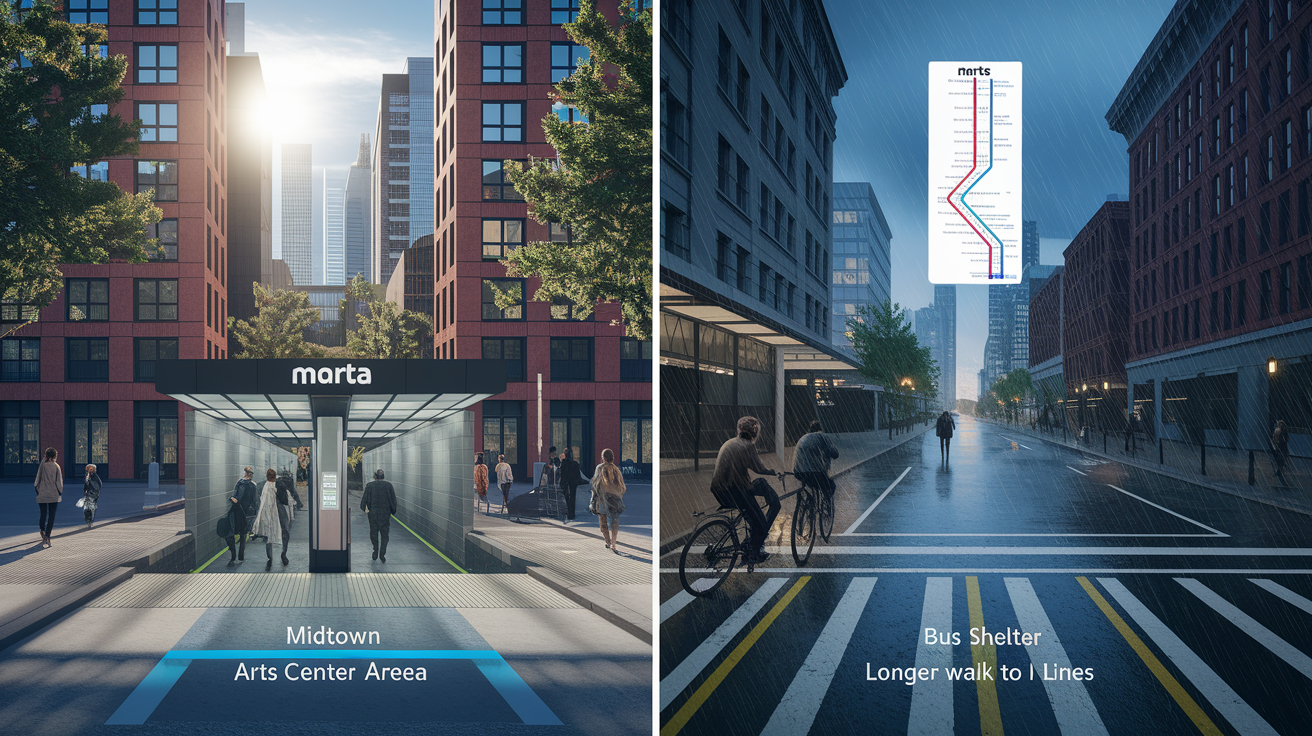
Midtown sits on the Red and Gold lines with three stations: Arts Center, Midtown, and North Avenue. Most addresses land within a half mile of one of those platforms. You’re talking a five to twelve minute walk, and then you’re on a train. Airport runs, downtown meetings, Buckhead shopping… rail becomes the default. You step outside, walk a few blocks, done. No planning, no transfer juggling, no backup ride.
Old Fourth Ward doesn’t have its own station. Edgewood–Candler Park sits on the eastern edge, serving Blue and Green lines. North Avenue anchors the west on Red and Gold. From most Old Fourth Ward addresses, you’re walking 15 to 25 minutes to reach either one. That’s fine on a clear morning. But when it’s raining, you’re hauling groceries, or you need to catch a specific train? It becomes a real barrier. Plenty of people bike or scooter to close the distance. Route 816 offers a bus bridge to Edgewood–Candler Park, but now you’re adding another layer of timing and wait.
Travel times show the gap. From Midtown Station, Five Points is about ten minutes. Airport runs average 25 minutes on a direct train. From Old Fourth Ward, you walk or connect to Edgewood–Candler Park or North Avenue first, then ride. That adds ten to twenty minutes depending on how the transfer lines up. If you’re commuting daily to the airport or a downtown office, those extra minutes pile up.
Station breakdown:
Arts Center Station (Midtown): Serves northern Midtown, easy walk from the Ansley Park edge, Red and Gold lines, frequent service all day.
Midtown Station (Midtown): Central hub at Peachtree and 10th, dense residential and commercial surroundings, Red and Gold lines, busiest Midtown stop.
North Avenue Station (Midtown/Old Fourth Ward border): Sits at the edge of both neighborhoods, walkable from western Old Fourth Ward but closer to Midtown’s core, Red and Gold lines.
Edgewood–Candler Park Station (Old Fourth Ward edge): Nearest Blue and Green line access, 15+ minute walk from the Ponce corridor, lighter foot traffic.
No dedicated Old Fourth Ward station: Residents rely on perimeter access, which cuts into spontaneous rail use compared to Midtown’s embedded station network.
Bus Network Coverage and Route Reliability

Midtown’s bus network crisscrosses like a grid. Multiple MARTA routes run along Peachtree, Piedmont, and the east-west corridors, with tight intervals during rush hours and steady midday service. Routes converge near the rail stations. Miss a train or need an alternate path? Another bus shows up within ten to fifteen minutes. Weekend service holds steady, so skipping a car for errands or evening plans actually works.
Old Fourth Ward bus coverage is thinner. Route 816 runs along North Avenue and ties into Edgewood–Candler Park Station, working as the main east-west bus link. Route 3 connects Ponce de Leon Avenue into downtown. Both run less often than Midtown’s network. Twenty to thirty minute intervals are common, and weekend schedules thin out even more. Miss your bus and the wait doubles your trip time, especially Sunday afternoon.
That lower frequency creates real friction. You start planning around the bus schedule instead of just stepping outside when you’re ready. For someone working flexible hours or managing pickups and drop-offs, the lack of backup routes turns public transit from convenient to stressful. Midtown riders don’t deal with that trade-off nearly as often because the dense route network offers built-in redundancy.
Walkability and Pedestrian Transit Access

Midtown sidewalks are continuous, wide, well lit. Commercial zoning fills the ground floors along Peachtree, Piedmont, and 10th Street. You pass storefronts, coffee shops, crosswalks with pedestrian signals every couple of blocks. That density keeps foot traffic high and makes walking to a MARTA station feel safe and straightforward, even after dark. Crossings are frequent. Drivers expect pedestrians, which matters when you’re trying to reach a station quickly.
Old Fourth Ward’s pedestrian experience splits into two zones. The BeltLine corridor and Ponce City Market area offer excellent walking infrastructure. Packed trails, active retail, good lighting, constant activity. But once you move east or south away from those anchors, sidewalk quality drops. Some blocks have narrow or broken sidewalks, fewer crosswalks, longer stretches between destinations. That unevenness makes reaching a MARTA station less intuitive, especially coming from the quieter residential pockets.
Walkability factors affecting transit access:
Sidewalk continuity: Midtown maintains connected sidewalks across the entire neighborhood. Old Fourth Ward has gaps in less developed blocks.
Lighting and visibility: Midtown’s commercial corridors stay lit at night. Old Fourth Ward lighting varies, with the BeltLine well lit but side streets darker.
Crossing safety: Midtown benefits from frequent signals and marked crossings. Old Fourth Ward has fewer pedestrian signals away from Ponce and the BeltLine, requiring longer walks to safe crossings.
Commute Times to Major Destinations

The table below shows average one-way commute times from each neighborhood to common Metro Atlanta destinations, combining walk time to the nearest station, ride duration, and any required transfers.
| Destination | Midtown Avg Time | Old Fourth Ward Avg Time |
|---|---|---|
| Five Points (Downtown) | 15–18 minutes | 30–35 minutes |
| Hartsfield–Jackson Airport | 30–35 minutes | 45–55 minutes |
| Buckhead (Lenox Station) | 12–15 minutes | 35–40 minutes |
| Decatur (Decatur Station) | 25–30 minutes (requires transfer at Five Points) | 20–25 minutes (direct from Edgewood–Candler Park) |
| Lindbergh Center | 8–10 minutes | 30–35 minutes |
Midtown delivers faster, simpler trips because your walk to the train is short and most destinations need only one train line. Old Fourth Ward adds time at both ends. Longer station walks, more frequent transfers. The exception is Decatur, where Edgewood–Candler Park offers a direct Blue or Green line connection, shaving minutes off the Midtown route that requires a Five Points transfer. For daily airport commuters or downtown office workers, Midtown’s time savings add up to hours each week.
Transit Maps and Navigational Guidance

MARTA’s rail map shows Midtown wrapped by the Red and Gold lines, with three labeled stations clustered in a compact area. That visual clarity matches what you see on the ground. Residents rarely study a map because the stations are visible landmarks and directional signs are everywhere. Bus route maps for Midtown look dense, with overlapping lines that reinforce the idea you can walk a few blocks and find another option.
Old Fourth Ward’s map position is less intuitive. The neighborhood sits between North Avenue and Edgewood–Candler Park stations but isn’t directly labeled on most MARTA maps. First-time visitors often assume Old Fourth Ward has a dedicated station, then discover they need to walk farther than expected. The BeltLine adds helpful wayfinding for cyclists and pedestrians, but it doesn’t connect directly to MARTA rail yet. You still navigate a gap between trail access and train platforms.
Future Transit Developments Affecting Both Neighborhoods

Planned BeltLine rail segments could reshape Old Fourth Ward’s transit profile over the next decade. If the eastern loop gets funding and construction moves forward, Old Fourth Ward would gain multiple light rail stops, linking Ponce City Market, the Krog Street corridor, and other dense developments directly to the MARTA network. That change would close the current station access gap and bring Old Fourth Ward closer to Midtown’s level of transit convenience.
Midtown stands to benefit from proposed bus rapid transit (BRT) routes along Peachtree Street and potential express connections to the new Westside developments. These projects would add faster, higher capacity service without requiring new rail construction. Midtown’s existing density and ridership volumes make it a natural first phase for BRT pilots, which could cut commute times further and improve reliability during peak hours.
Planned projects and expected impacts:
BeltLine Light Rail (Old Fourth Ward segment): Would add multiple stations within walking distance of most Old Fourth Ward addresses, potentially matching Midtown’s station density.
Peachtree Street BRT (Midtown corridor): Faster peak-hour service, dedicated lanes, fewer stops than local buses. Could cut north-south commute times by 5 to 10 minutes.
Eastside Trail Transit Connections (Old Fourth Ward): Proposed station integration near Ponce City Market and Krog Street would allow seamless BeltLine to MARTA transfers.
North Avenue Complete Street Redesign: Improved pedestrian crossings and bike lanes along the Midtown/Old Fourth Ward border, making North Avenue Station more accessible from both neighborhoods.
Resident and Commuter Experiences

Midtown residents consistently describe transit as their default. You don’t think about whether MARTA will work. You just use it. The stations are close, trains run frequently, and backup bus routes soften any delays. That reliability shows up in how people organize their lives: fewer cars per household, less parking anxiety, more spontaneous trips to the airport or a Braves game.
Old Fourth Ward residents value the neighborhood’s walkability and the BeltLine’s connectivity, but they’re more cautious about relying exclusively on MARTA. The longer station walks and thinner bus coverage mean you plan trips more carefully and keep a backup. A bike, a scooter, a car share account. It’s not that transit doesn’t work, but it takes more intention. You check schedules, allow buffer time, and sometimes choose to drive when you wouldn’t in Midtown.
For daily airport commuters or people working downtown, that difference is decisive. Midtown offers the car-free or car-light lifestyle without compromise. Old Fourth Ward offers most of the walkability benefits but asks you to solve the last-mile problem yourself.
Final Words
Midtown has the edge for direct MARTA — three stations within 5–12 minute walks, denser buses, and quicker one-seat rides to Downtown and the airport. Old Fourth Ward lacks a dedicated station and leans on nearby stops, Routes 816/3, and the BeltLine, so expect longer walks or transfers.
For a quick Midtown vs Old Fourth Ward transit and public transportation access comparison: pick Midtown for fastest rail and buses; pick Old Fourth Ward for walkability and BeltLine access. Either way, check real walk times and service frequency during your commute — both neighborhoods can work.
FAQ
Q: Do I need a car in Midtown Atlanta?
A: You don’t necessarily need a car in Midtown Atlanta. Midtown has multiple MARTA stations, high walkability (about 91), and frequent buses—great for daily errands and commuting. A car helps for suburbs, big grocery trips, or evening drives.
Q: Is it better to stay in Midtown or Buckhead?
A: Whether it’s better to stay in Midtown or Buckhead depends on priorities. Midtown offers stronger MARTA access, walkability, and nightlife; Buckhead offers upscale shopping, quieter residential streets, and more parking—better if you prefer driving and luxury retail.
Q: Is downtown or midtown more walkable in Atlanta, and is it better to stay in Midtown or downtown Atlanta?
A: Midtown is generally more walkable than Downtown. Midtown has denser sidewalks, closer MARTA stations, and more restaurants. Stay Midtown for transit and nightlife; stay Downtown if you need close-to-office or courthouse access.