


Lenders quietly tightened rules in 2024 — and that changes what Atlanta buyers can actually afford.
Higher score floors, lower debt-to-income (DTI = your monthly debts divided by gross income) caps, stricter income checks, and bigger reserve rules mean a lot of buyers qualify for less, even with the same pay and down payment.
If you planned to shop Midtown, Decatur, or Brookhaven the same way as last year, you’ll want to reset expectations.
This post explains which rule shifts matter, how they cut buying power in Atlanta neighborhoods, and the practical steps to get back in the game.
Key Mortgage Qualification Changes Impacting Atlanta Buyers

Lenders across Atlanta tightened qualification rules through 2024 and into 2025. Higher home prices, rising default worries, and shifting federal policy all played a part. Credit score minimums went up for conventional, FHA, and portfolio loans. A lot of conventional lenders now save their best rates for borrowers with 700 or above. FHA approvals under 620? You’re looking at extra overlays and steeper costs. Debt-to-income ceilings dropped too. Many lenders pulled back from 50 percent to 45 or even 43 percent on certain products. These changes shrink the monthly payment a buyer can handle, which cuts the top price they can afford, even when income and down payment don’t budge.
Income verification got stricter. Lenders want deeper documentation on variable pay like overtime, bonuses, commissions. Self-employed buyers? Expect longer reviews of profit-and-loss statements and bank deposits. The tighter stance came fast after defaults ticked up nationwide, and Atlanta lenders jumped on those overlays given the competitive market and median prices sitting near $420,000.
Down payment expectations shifted right alongside everything else. Home values climbed, so buyers putting 5 percent down now bring way more cash to closing than they did two years back. Lenders started asking for bigger reserves, often two to four months of mortgage payments sitting in verified accounts before they’ll approve low-down-payment loans. First-time buyers feel that pinch hardest, especially if they’re counting on family gifts or thin savings to get to the table.
Put it all together, and these rule changes cut down the pool of qualified buyers and slash the purchase price a lot of Atlanta households can reach right now. Knowing each piece helps you prep and reset expectations before you start looking.
Credit Score Rule Adjustments and Their Effects in Atlanta

Plenty of conventional lenders bumped their effective minimum from 620 to 640 or even 660 for standard pricing during 2024. If you’re under 700, you’ll pay higher loan-level price adjustments. Those show up as extra fees (a percentage of your loan amount) that can tack thousands onto closing costs or nudge your rate up by a quarter point or more. FHA still accepts scores as low as 580 with 3.5 percent down. But Atlanta lenders often add overlays requiring 600 or 620 to actually qualify. That kicks out buyers who used to squeak by at 580 and leaned on FHA to get in.
Portfolio lenders and credit unions tightened score floors too. A 680 that once meant smooth sailing now gets extra review. Anything below 660 triggers close looks at payment history, collections, recent credit pulls. Lenders got cautious in a market where prices outran incomes, raising the chance that borderline borrowers might stumble if values flatten or rates stay high.
What borrowers see from credit score adjustments:
- Scores between 620 and 700 mean higher fees or rates, which cuts what you can actually afford.
- First-timers carrying student loans or medical collections often slip below new thresholds and have to pause to fix credit.
- Repeat buyers with solid equity but mid-600s scores face fewer loan choices and tougher underwriting.
- Buyers counting on down payment assistance discover lots of programs now want 640 to 660 minimum, locking out lower-score folks.
Updated Debt-to-Income Standards in the 2024-2025 Market

Max DTI ratios came down across loan types. Conventional loans that used to allow 50 percent back-end DTI now cap at 45 percent for most borrowers. Some lenders went tighter to 43 percent unless you’ve got compensating factors like big reserves or a chunky down payment. That shift means a buyer grossing $8,000 a month can support a max total monthly obligation of $3,440 to $3,600, down from $4,000 under the old 50 percent rule. That $400 to $560 monthly drop translates straight into lower max purchase price.
FHA and VA loans technically permit DTI as high as 55 or even 60 percent with manual underwriting. But most Atlanta lenders cap back-end ratios at 50 percent with overlays. Portfolio lenders offering non-QM products keep higher DTI flexibility but charge premium rates, usually 1 to 2 points above conforming loans. The changes hit hardest in neighborhoods where prices climbed faster than wages. Think parts of Midtown, Brookhaven, Decatur, where median lists top $500,000 and monthly payments strain DTI limits even for well-paid professionals.
Here’s an example. A buyer earning $120,000 yearly ($10,000 gross monthly) with $600 in non-housing debt can support a max housing payment of $3,900 under a 45 percent DTI cap. Do the math: $10,000 × 0.45 = $4,500 total debt, minus $600 existing debt = $3,900. At 7 percent interest, that $3,900 covers principal, interest, taxes, insurance, HOA on roughly a $475,000 purchase. Under the old 50 percent rule? Same buyer qualified for $525,000. That $50,000 gap closes the door on a bunch of listings in competitive Atlanta submarkets where inventory under $500,000 stays tight.
Down Payment Expectations and Affordability Pressures in Atlanta

Atlanta’s median home price jumped from around $360,000 in early 2023 to near $420,000 by late 2024. That increase bumps the dollar amount needed for common down payment percentages. A 5 percent down payment that used to need $18,000 now wants $21,000. Ten percent went from $36,000 to $42,000. These jumps squeeze first-time buyers who saved based on older targets and now find their cash short. Lenders also tightened reserve requirements. Often they’re asking buyers putting down less than 10 percent to show two to four months of mortgage payments in verified bank accounts after closing. Forces you to hold back more savings instead of throwing every dollar at the down payment.
Low-down-payment programs saw fresh restrictions. Some Atlanta down payment assistance programs raised minimum credit scores to 640 or 660 and capped household income lower to focus on moderate earners. Lenders offering 3 percent down conventional loans added stricter overlays, including higher credit minimums and tighter max DTI, narrowing who qualifies. The result? Buyers who once got in with minimal cash now need way bigger sums to hit both down payment and reserve requirements.
Three common down payment shifts buyers run into:
- Minimum down payment percentages stayed put (3 percent conventional, 3.5 percent FHA), but dollar amounts rose with home prices, needing $3,000 to $6,000 more cash compared to 2023.
- Reserve requirements went up. Lots of lenders now want two months of PITI (principal, interest, taxes, insurance) verified in accounts after closing for loans under 10 percent down.
- Down payment assistance programs got pickier, raising credit minimums and lowering income caps, cutting the number of buyers who qualify for grants or forgivable loans.
Income Verification and Documentation Tightening

Lenders beefed up documentation requirements across all income types. W-2 employees now provide two years of tax returns even when pay stubs and employer verification letters confirm stable wages. The shift’s designed to catch unreported side income or tax filing hiccups. Buyers earning overtime, bonuses, commissions face deeper scrutiny. Underwriters now average variable income over 24 months instead of 12, and any recent earnings decline triggers questions or flat-out exclusion from qualifying calculations. Self-employed borrowers get the strictest review. You’ll need two full years of personal and business tax returns, year-to-date profit-and-loss statements, detailed explanations of any big deposits or transfers in bank accounts.
These changes really hit Atlanta’s workforce. A big chunk of buyers work in sales, consulting, tech contracting, other roles where variable pay makes up 20 to 40 percent of total income. Excluding or averaging down that income can drop a buyer’s qualifying amount by tens of thousands. Real estate agents, healthcare pros on call pay, gig workers face similar hassles. Lots discover mid-application that income they counted on doesn’t qualify under new rules.
Take a consultant earning $90,000 base plus $30,000 in yearly bonuses. Used to qualify using the full $120,000. Under tighter standards, the underwriter averages the last two years of bonus income. $30,000 in 2024 but only $20,000 in 2023, so they use $25,000 annually. Qualifying income drops to $115,000. That $5,000 slide lowers max purchase price by roughly $30,000 at current rates and DTI limits. Could push the buyer out of their target neighborhood or force them to boost their down payment to make up the gap.
How These Combined Changes Shift Buying Power in Atlanta
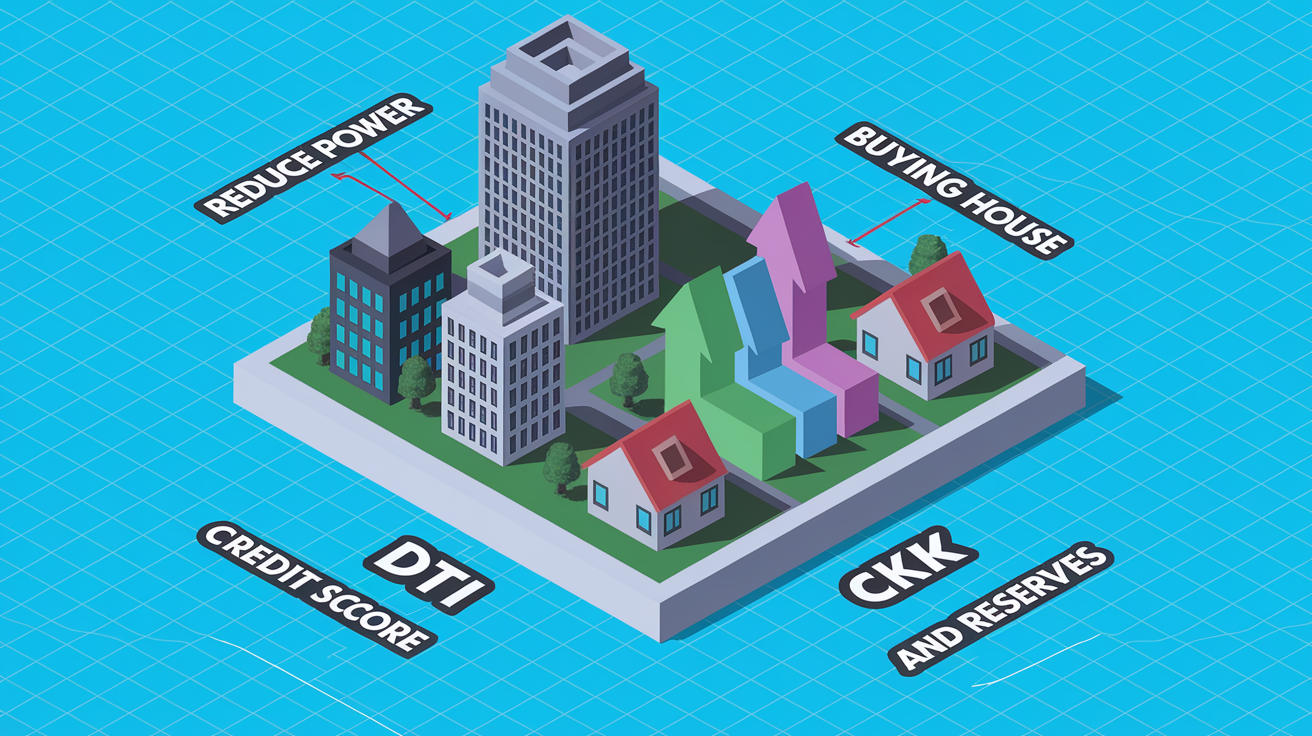
When credit score bumps, DTI tightening, down payment growth, and income verification all hit at once, the net effect narrows buying power across every buyer type. A first-timer who qualified for $350,000 in early 2023 with a 640 score, 5 percent down, 48 percent DTI now finds lots of lenders capping approval at $310,000 to $320,000 under revised standards. Repeat buyers with strong equity but variable income see similar cuts, as underwriters discount or toss out chunks of pay that used to count. The changes bite hardest in Atlanta’s competitive inner submarkets. Midtown, Virginia Highland, Inman Park, Decatur, where median prices topped $500,000 and inventory below that stays scarce.
Move-up buyers and investors face smaller hits but still run into friction. Higher credit score requirements and reserve mandates add cost and complexity. Tightened DTI limits force some buyers to stretch down payments or take slightly higher rates to stay within qualifying ratios. The shift also slows transaction timelines. Stricter documentation and underwriting review add days or weeks to approval, creating risk in a market where sellers still expect fast closes and clean financing.
| Buyer Type | Previous Qualifying Power | Current Qualifying Power | Change |
|---|---|---|---|
| First-time buyer, $80,000 income, 5% down, 640 score | $350,000 purchase | $310,000 purchase | −$40,000 (−11%) |
| Repeat buyer, $120,000 income, 10% down, 680 score | $525,000 purchase | $475,000 purchase | −$50,000 (−10%) |
| Self-employed, $100,000 qualified income, 15% down, 720 score | $450,000 purchase | $420,000 purchase | −$30,000 (−7%) |
| Investor, $150,000 income, 20% down, 740 score | $600,000 purchase | $575,000 purchase | −$25,000 (−4%) |
Action Steps Atlanta Buyers Can Take to Qualify Under New Rules

Getting ready early and fixing weak spots in credit, debt, documentation gives you the best shot to qualify under tighter standards. Start by pulling credit reports from all three bureaus. Dispute errors, pay down collections, knock credit card balances under 30 percent of limits. Even small score gains (moving from 680 to 700) can unlock better pricing and wipe out overlays that restrict loan options.
Five steps to beef up your application under revised standards:
-
Improve your credit score before applying. Pay down revolving balances, dispute mistakes, skip new credit inquiries for at least 90 days before pre-approval. Jumping from mid-600s into low 700s can save thousands in fees and open up loan choices.
-
Cut monthly debt obligations. Pay off small installment loans, trim credit card balances, ditch car payments to drop back-end DTI. Even a $200 monthly cut can lift your max purchase price by $30,000 to $40,000.
-
Get income documentation sorted early. Pull together two years of tax returns, recent pay stubs, W-2s, year-to-date profit-and-loss statements if you’re self-employed. Flag any income drops or big deposits and prep explanations before the underwriter asks.
-
Build bigger cash reserves. Save enough to cover down payment, closing costs, and two to four months of mortgage payments in verified accounts. Keeping reserves accessible after closing satisfies lender overlays and strengthens your approval.
-
Check out Atlanta down payment assistance programs early. Lots of programs got pickier, so confirm credit minimums, income caps, required homebuyer ed courses before you start shopping. Working with a lender who knows local assistance options helps you stack programs with conventional or FHA loans to max out buying power.
Final Words
in the action: lenders are raising credit score floors, tightening DTI limits, nudging up down‑payment expectations, and asking for more income paperwork.
In Atlanta, with median prices near $420,000 and heavy competition, these shifts shrink what you can afford and change offer strategy, especially for first-time buyers. That means planning earlier, improving credit, saving more, and getting documents ready.
Use the action steps above, talk to a local lender, and map your budget. This is how mortgage qualification changes will affect atlanta buyers, but with a focused plan you can still compete.
FAQ
Q: What is the 3 7 3 rule in mortgage?
A: The 3 7 3 rule in mortgage is not a widely recognized industry standard; when you hear it, ask the lender for specifics because it’s often an internal guideline affecting qualifying or pricing.
Q: Are home prices dropping in Atlanta?
A: Home prices in Atlanta are showing localized softening, not broad declines; median prices sit near $420,000 and competition remains elevated, so affordability varies by neighborhood and price range.
Q: Can a 70 year old woman get a 30 year mortgage?
A: A 70-year-old woman can get a 30-year mortgage; lenders focus on income, credit, and repayment ability rather than age, though they may require more documentation or reserves in Atlanta.
Q: Will mortgage rates ever go to 3% again?
A: Mortgage rates could return to 3% eventually, but it’s uncertain; rates depend on inflation, Fed policy, and economic trends, so plan using current realistic rates and shop multiple lenders.