


What if Atlanta suburbs stop being the “bargain” and overtake city prices by 2026?
Suburban medians are now just a few thousand below the core after years of fast growth, and big job projects plus new construction are pushing values outward.
If you’re buying to benefit from appreciation, where you park your money—Duluth, Jackson County, or East Atlanta—matters more than the old city-versus-suburb argument.
This post shows the numbers, the demand and supply drivers, and which micro-markets should appreciate faster through 2029.
Comparative Overview of Atlanta Suburb vs. City Home Price Growth Outlook
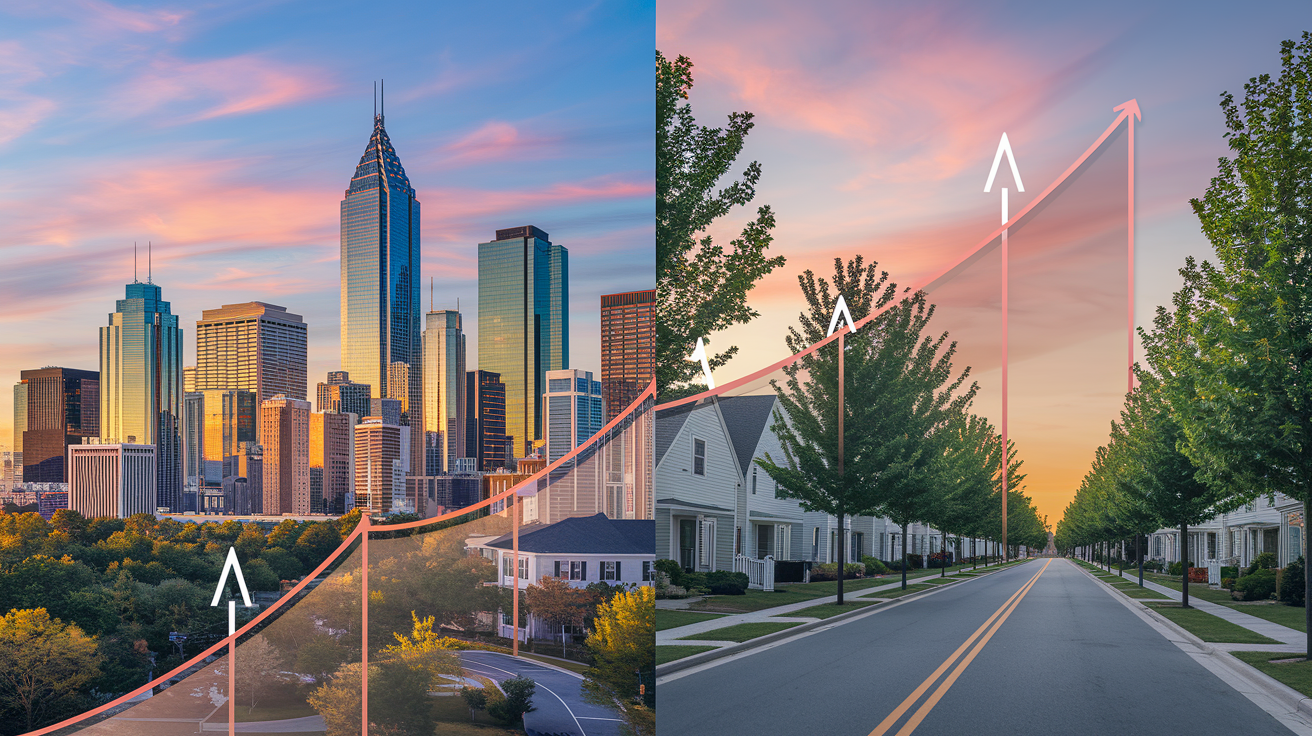
By the end of 2025, Atlanta’s outer suburbs hit a median sale price around $380,962. That’s just a few thousand below the metro core median. The gap has shrunk dramatically since 2021, when suburban homes typically sold for about $51,000 less than properties closer to downtown.
Analysts tracking Metro Atlanta now think suburban home prices could actually cross over and surpass city-core prices sometime in 2026. If that happens, it’ll flip the script on what buyers have historically seen as “discount” markets versus premium urban real estate.
Through 2029, the metro-wide forecast calls for steady annual appreciation of 3 to 4 percent. But within that broader outlook, certain suburbs are projected to outpace the average. Duluth and Sandy Springs at 4 to 6 percent annually, for example. Select revitalizing urban neighborhoods like East Atlanta and Grant Park may hit 5 to 7 percent annual gains. Both sides of the metro will grow, but specific pockets on each side will outperform depending on demand drivers, inventory constraints, and job-market proximity.
Projected growth comparison over the next five years:
- Outer suburbs (fastest growth areas): 4 to 6% annual appreciation, roughly 22 to 33% cumulative by 2029
- City core (average baseline): 3 to 4% annual appreciation, roughly 15 to 20% cumulative by 2029
- Urban revitalization pockets: 5 to 7% annual appreciation, roughly 28 to 40% cumulative by 2029
- Established inner suburbs: 3 to 5% annual appreciation, roughly 15 to 27% cumulative by 2029
| Area | 2025 Baseline Median | Forecast Annual Appreciation % |
|---|---|---|
| City Core (Buckhead, Midtown) | ~$385,000 | 3–4% |
| Inner Suburbs (Sandy Springs, Brookhaven) | ~$375,000 | 4–6% |
| Fast-Growth Outer Suburbs (Duluth, Monroe, Jackson County) | ~$380,000 | 4–6% |
Drivers Behind Atlanta Suburban Price Growth Acceleration

Population movement tells the clearest story. Between 2019 and 2024, Jackson County added roughly 25 percent more residents while Fulton County grew just 3.9 percent. That demographic surge reflects families, remote workers, and retirees choosing affordable land, newer construction, and proximity to both Atlanta jobs and smaller-town quality of life.
Large-scale employment projects are anchoring that demand. SK Battery America’s facility in Jackson County created more than 2,500 jobs. Rivian’s planned electric-vehicle plant near Covington is expected to add about 7,500 jobs by 2030. Those aren’t just factory roles. They pull in suppliers, support businesses, housing for management, and secondary commercial development. When a major employer lands within 30 to 60 miles of Atlanta, it shifts buyer patterns outward.
Lifestyle amenities are pulling weight too. Monroe offers historic charm and walkable shopping districts. The Chateau Elan area brings resort-style living. Golf courses, a winery, a spa, all within commuting range of Metro Atlanta jobs. Buyers looking for space, newer schools, and weekend recreation without leaving the region are bidding suburban inventory higher.
Supply constraints amplify every demand shift. Limited inventory in many suburban communities means more competition for every listing, which pushes prices up faster. First-time buyers and renters face shrinking affordability as appreciation outpaces local wage growth.
Top suburban demand drivers fueling faster appreciation:
- Major job-project radius (SK Battery, Rivian within 30 to 60 miles of core metro)
- School district reputation and capacity in growing counties
- High-amenity communities (resort areas, historic downtowns, golf and winery destinations)
- Commute flexibility for hybrid and remote workers
- Land availability for new single-family construction at lower price points than city core
City Core Home Price Trajectory and Urban Appreciation Indicators

Core Atlanta neighborhoods remain strong, though the growth story varies block by block. Revitalizing areas like East Atlanta and Grant Park are forecast to appreciate 5 to 7 percent annually through 2029. Walkability, mixed-use redevelopment, and younger buyers prioritizing transit access and neighborhood vibrancy over yard size are driving that.
Established urban submarkets like Buckhead, Sandy Springs, and Brookhaven are also projected to outperform the metro average into 2026 and beyond. These areas combine mature amenities, top-rated schools, MARTA access, and job proximity. Buyers willing to pay a premium for shorter commutes and urban convenience keep bidding those neighborhoods higher, even as outer suburbs close the price gap.
The condo-versus-single-family split matters in the city core. Single-family homes in walkable urban pockets tend to hold value better and appreciate faster than condo inventory, especially high-rise units. Single-family supply inside I-285 is extremely limited. Condo appreciation is more vulnerable to oversupply and HOA cost increases, which can moderate buyer demand and slow price growth compared to detached homes on land.
Breakdown of Key Suburbs and Neighborhood-Level Price Forecasts
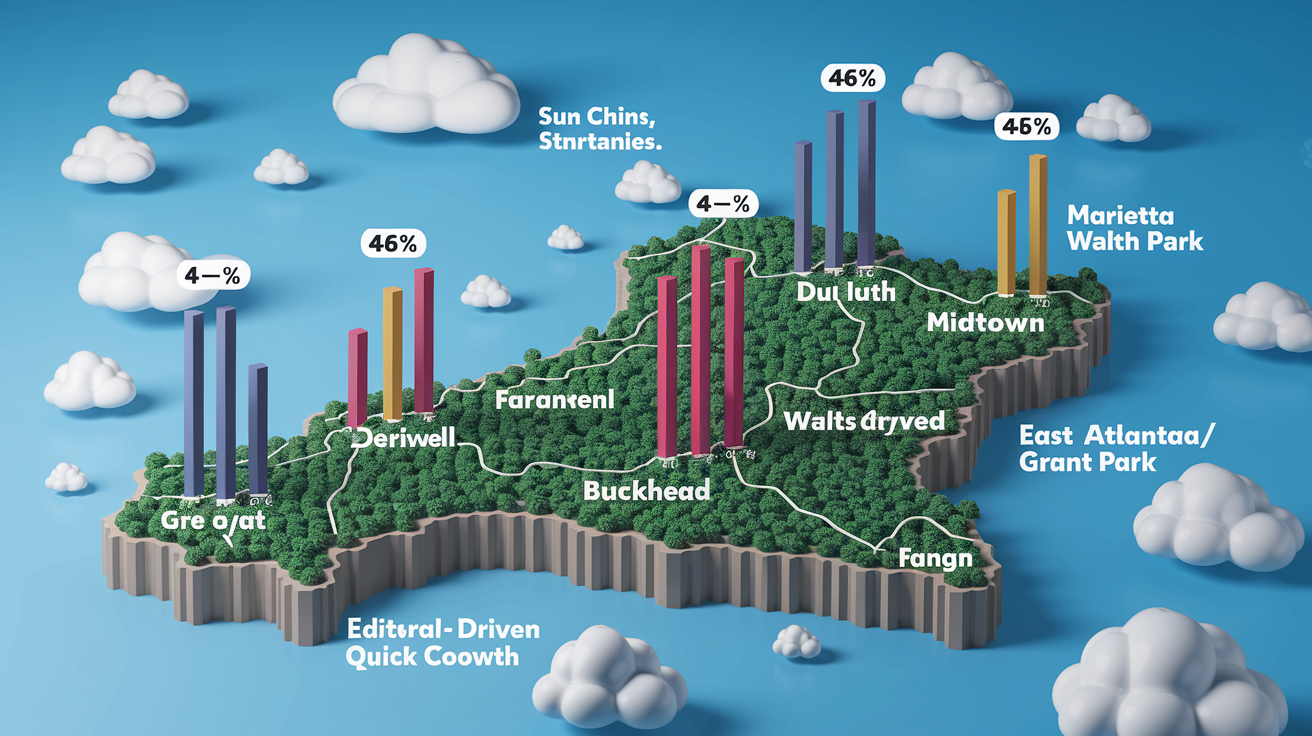
North suburbs anchor the high-growth forecast. Duluth and Sandy Springs are projected at 4 to 6 percent annual appreciation through 2029, fueled by strong schools, corporate relocations, and steady job growth in technology and logistics. Alpharetta continues to draw tech employers and move-up buyers, tracking similar 4 to 6 percent annual gains with median prices already above $400,000 in many ZIP codes.
East of Atlanta, Jackson County and Walton County (Monroe area) are hot spots. Jackson County’s rapid population growth and the SK Battery facility are driving new-home construction and appreciation in the 4 to 6 percent annual range. Monroe benefits from historic charm and proximity to planned Rivian jobs, positioning it for steady demand and price growth over the next five years.
West and northwest suburbs like Marietta and Roswell are expected to track closer to the metro average, 3 to 4 percent annually. These are stable, family-friendly markets with good schools and mature infrastructure, but they lack the same job-project catalysts or supply shortages driving faster growth in eastern and northern suburbs. They offer predictable appreciation without the volatility of revaluation markets.
Urban comparison: East Atlanta and Grant Park’s 5 to 7 percent projected annual gains outpace most suburbs, making them the top performers if walkability and urban lifestyle are priorities. For buyers choosing between city and suburbs based purely on appreciation potential, the answer depends on micro-location and personal trade-offs. Commute time, school preference, and tolerance for density.
| Area/Neighborhood | 2025 Baseline Median | 2026–2029 Annual Forecast % |
|---|---|---|
| Duluth (North Suburb) | ~$390,000 | 4–6% |
| Sandy Springs (Inner Suburb) | ~$385,000 | 4–6% |
| Monroe / Walton County (East Suburb) | ~$370,000 | 4–6% |
| Marietta / Roswell (West/Northwest Suburb) | ~$375,000 | 3–4% |
| East Atlanta / Grant Park (Urban Revitalization) | ~$360,000 | 5–7% |
| Buckhead / Midtown (Urban Core) | ~$425,000 | 3–4% |
Fastest-rising areas to watch based on forecasted demand and supply constraints:
- Jackson County (job growth, new construction, population surge)
- East Atlanta and Grant Park (urban revitalization, walkability premium)
- Duluth and northern Gwinnett corridor (tech jobs, schools, infrastructure)
- Monroe and Walton County (amenity-driven demand, Rivian proximity)
Inventory, Supply Dynamics, and How They Shape Future Price Growth

Atlanta’s single-family housing supply sits around 3 to 4 months of inventory, which is tight enough to support continued price growth. A balanced market typically carries 5 to 6 months of supply, so the metro remains tilted in favor of sellers. That imbalance affects suburbs and city core differently. Suburbs with active new-home construction can add supply incrementally, while the city core has limited land for detached housing, keeping urban single-family inventory especially constrained.
The Atlanta Regional Commission estimates the metro needs roughly 500,000 additional housing units by 2050 to keep pace with population and job growth. In 2025 alone, more than 10,000 new apartment units are expected to come online, mostly in mixed-use and transit-adjacent locations. That multifamily pipeline helps renters and condo buyers but does little to ease single-family supply shortages, which are the primary driver of home-price appreciation for buyers purchasing detached houses.
New construction in outer suburbs can moderate appreciation slightly by adding supply where demand is surging. Subdivisions in Jackson County and Walton County are delivering homes in the mid-$300,000s, creating alternatives to bidding wars on existing inventory. In contrast, urban infill projects face higher land costs and zoning complexity, limiting the pace of new supply inside I-285. That structural difference means suburban appreciation may slow modestly as builders catch up to demand, while city-core single-family homes remain supply-constrained and could hold or accelerate their appreciation rates if buyer preference shifts back toward shorter commutes and walkability.
Mortgage Rate Scenarios and Their Influence on City vs Suburb Appreciation

Mortgage rates are currently running around 6.5 to 7.0 percent for a 30-year fixed loan. Forecasts project a gradual decline to roughly 5.5 to 6.0 percent by 2028 or 2029, assuming the Federal Reserve continues easing policy without triggering renewed inflation. That rate drop would improve monthly affordability and could unlock homeowners who’ve been reluctant to sell and give up their existing low rates from 2020 to 2021.
Suburbs tend to be more rate-sensitive than the city core because suburban buyers are often stretching their budgets to get more space, and every quarter-point change in rate affects their purchasing power. A drop from 6.5 to 5.5 percent could add tens of thousands of dollars to a buyer’s budget, which in turn fuels higher bids on suburban homes. City-core buyers are more often move-up or downsizing households with larger down payments and less reliance on maximum loan amounts, so their demand is less volatile when rates shift.
Lower rates also introduce a double-edged effect. They increase buyer demand (upward pressure on prices) while encouraging more existing homeowners to list (which adds supply and moderates price growth). The net outcome depends on timing and local inventory levels. In suburbs with new construction pipelines, rate drops may bring balanced growth. In supply-constrained urban pockets, rate drops could accelerate bidding wars and push appreciation higher.
Price-impact scenarios under different mortgage rate paths:
- Best case (rates drop to 5.5% by 2028): suburbs gain 5 to 7% annually as affordability improves and new buyers flood the market. City core gains 4 to 5% as move-up demand strengthens.
- Base case (rates ease to 6.0% by 2029): suburbs grow 4 to 6% annually. City core grows 3 to 4% annually (current forecast).
- Worst case (rates remain above 6.5% through 2029): suburbs slow to 2 to 3% annually as affordability constraints limit buyer pools. City core holds 2 to 3% due to investor and cash-buyer resilience.
Risk Factors That Could Alter Atlanta Suburb vs City Price Projections

Affordability pressures are the most immediate risk to sustained appreciation. Price-to-income ratios in Metro Atlanta have risen faster than local wage growth, which limits the pool of first-time buyers who can qualify for mortgages at current prices and rates. If appreciation continues at 4 to 6 percent annually while household incomes grow only 2 to 3 percent, fewer buyers will be able to enter the market, eventually moderating demand and slowing price growth.
Economic uncertainty could disrupt the forecast. National recession, rapid interest-rate spikes, or major employer pullbacks. Atlanta’s job market has been resilient, but a sharp downturn would reduce migration into the metro, slow new-job creation, and increase foreclosure or distressed-sale inventory. Suburbs with economies heavily tied to single large employers (for example, areas around new EV plants) face concentrated risk if those projects delay or downsize.
Climate and flooding exposure affect specific neighborhoods more than others. Low-lying areas near rivers, creeks, and older stormwater infrastructure face increasing flood risk, which can depress long-term value and limit buyer financing options (lenders require flood insurance, which adds monthly cost). Buyers and investors should review FEMA flood maps and factor climate resilience into location decisions, especially in east and south metro suburbs where development has expanded into floodplains.
Actionable Insights for Buyers, Sellers, and Investors Based on Forecast Trends

Buyers entering the market in 2026 will find more room to negotiate than in recent years. Multiple-offer situations have cooled, and inventory is slightly higher, around 4 months of supply in many submarkets. That shift favors buyers willing to act quickly with strong financing (full loan approval, meaningful down payment, or cash), especially in suburbs where competition remains tighter than the city core. Move-up buyers have particularly favorable conditions because they can sell their existing home into a still-strong market and buy with improved negotiating power.
Target neighborhoods depend on your goals. For highest short-term appreciation, focus on East Atlanta, Grant Park, or northern suburbs like Duluth and Sandy Springs, which are forecast at 4 to 7 percent annual gains. For stable family-friendly growth with lower volatility, Marietta and Roswell offer predictable 3 to 4 percent annual appreciation and strong schools. For investment upside tied to major job projects, Jackson County and areas near the Rivian plant (Covington, Walton County) present higher risk but potentially outsized returns if development accelerates as planned.
Sellers should lean into current market strength. The combination of low foreclosure rates, tight single-family supply, and steady demand means 2026 through 2029 remains seller-friendly. Strategic pricing and targeted upgrades (updated kitchens, finished outdoor spaces, fresh paint) maximize return without over-investing in renovations. Turnkey homes consistently outperform listings that need cosmetic work, so address basic maintenance and consider a pre-listing inspection to eliminate surprises that could kill deals during buyer due diligence.
Investors should differentiate between cash-flow and appreciation plays. Single-family rentals in stable suburbs (Marietta, Roswell) offer modest 2 to 3 percent rent growth and steady tenant demand, suitable for buy-and-hold strategies. Higher-appreciation neighborhoods (East Atlanta, Grant Park, Duluth) present stronger equity-growth opportunities but may carry higher entry prices and more tenant turnover. Avoid over-concentrating in any single suburb tied to one major employer. Diversify locations to manage job-market concentration risk.
Best opportunities over the next 3 to 5 years based on forecasted appreciation, inventory, and risk:
- East Atlanta and Grant Park: 5 to 7% annual gains. Urban lifestyle premium. Limited single-family supply. Moderate climate and flood risk in specific blocks, so verify drainage and FEMA maps.
- Duluth and Sandy Springs: 4 to 6% annual gains. Strong schools and corporate demand. Steady inventory from new construction. Low macro risk.
- Jackson County and Monroe (Walton County): 4 to 6% annual gains. Major job projects (SK Battery, Rivian proximity). Higher speculative risk if projects delay. Strong upside if growth materializes.
- Marietta and Roswell: 3 to 4% annual gains. Predictable family-market demand. Lower volatility. Suitable for conservative investors and long-term homeowners.
- Buckhead and Midtown single-family pockets: 3 to 4% annual gains. Established wealth and walkability. Very limited supply. Higher entry price but stable long-term value.
Final Words
Here’s the short version: suburbs have closed most of the price gap and could overtake city medians soon, while both city pockets and select suburbs keep outpacing the metro average.
You read the drivers (jobs, migration, low supply), neighborhood forecasts, rate scenarios, and risks—plus clear takeaways for buyers, sellers, and investors. Expect roughly 3–4% annual metro growth, hot pockets at 4–7%, and suburbs possibly overtaking city medians in 2026 if trends hold.
Use this forecast for atlanta suburbs vs city home price growth to pick your area, run the numbers, and move with confidence.
FAQ
Q: What is the real estate outlook for 2026 in Atlanta?
A: The real estate outlook for 2026 in Atlanta is modest growth — roughly 3–4% metro appreciation, with some suburbs possibly outpacing the city and stronger gains (4–7%) in hot pockets.
Q: What part of Atlanta to stay away from?
A: The parts to avoid in Atlanta depend on your priorities; generally steer clear of blocks with flood exposure, consistently poor school ratings, or recent crime spikes — verify with local crime maps and a daytime/nighttime drive.
Q: Why is 2026 a significant year for Atlanta?
A: The year 2026 is significant for Atlanta because it’s a potential inflection year — suburban medians may overtake city prices, and inventory plus job-driven demand are shifting where buyers find growth.
Q: Is $90,000 a good salary in Atlanta?
A: A $90,000 salary in Atlanta is a solid middle-class income — comfortable in many OTP suburbs and some intown areas, but affordability depends on your debt, family size, and neighborhood choice (Buckhead vs outer suburbs).