

Think buying in DeKalb County is out of reach because you don’t have a big down payment?
DeKalb offers a true grant equal to 1 to 3 percent of your mortgage for down payment and closing costs.
You don’t always have to be a first-time buyer, and you won’t owe the money later.
This intro shows the DeKalb program, Georgia Dream and other statewide options, who qualifies, and what lenders need.
Read on for clear steps you can start today to get pre-approved, stack programs, and cut the cash you must bring to closing.
Key DeKalb County Homebuyer Assistance Options and How They Work

DeKalb County offers buyers a grant that’s equal to 1 to 3 percent of your mortgage amount. The money covers down payment and closing costs, and how much you get depends on your interest rate. Lock in a lower rate and you’ll probably land somewhere in the middle of that range. Higher rate? You might qualify for the full 3 percent.
Here’s what makes this different. You don’t have to be a first-time buyer. If you’ve owned before but meet the program’s requirements, you’re eligible. That opens things up for a lot more people trying to buy in DeKalb.
It’s a true grant. You don’t pay it back. There’s no second lien sitting on your property. You’ll need a 30-year fixed mortgage through a participating lender, and that lender handles both the loan and the grant application at the same time. Your rate matters because it determines your grant size, so it’s worth understanding that connection before you lock anything in. The lender confirms you’re eligible, processes everything, and makes sure the grant money shows up at closing.
The whole thing is lender-driven. You call a participating lender, fill out a mortgage application, and they figure out if you meet the credit, income, and debt-to-income standards for both the county program and whatever loan product you’re using. Once you’re approved, the grant reduces the cash you need to bring to closing. It’s all part of the same transaction instead of a separate approval process.
What you get with the DeKalb County program:
- No repayment: the grant doesn’t turn into a second mortgage, and you won’t owe anything back if you sell or refinance later
- Grant size tied to your rate: assistance runs between 1 and 3 percent based on the actual mortgage rate you qualify for
- Not just for first-timers: previous homeowners can use it if they meet credit and income standards
- One application: your lender handles the mortgage and the grant together
- Covers multiple costs: you can use the funds for down payment, title fees, appraisal, and other standard closing expenses
- Works with common loan types: pairs with conventional, FHA, VA, and USDA loans through approved lenders
Eligibility Requirements for DeKalb County Homebuyer Programs

DeKalb County sets a household income cap at $134,960. You’ve also got to meet the lender’s credit score requirements, keep your debt-to-income ratio in check, and stay within loan amount limits. The program doesn’t allow nonoccupant co-borrowers or co-signers. Everyone on the loan has to live in the home.
Liquid asset limits vary. Georgia Dream restricts you to $20,000 or 20 percent of the purchase price, whichever is higher. Other statewide programs either set different thresholds or skip asset limits entirely. You’ll need to occupy the home as your primary residence, and most programs require completion of a homebuyer education course before you close.
Credit minimums range from 580 to 640 depending on which assistance program you combine with your mortgage. Debt-to-income ratios usually can’t go past 43 to 45 percent of gross monthly income, though some lenders and loan products will stretch higher if you’ve got compensating factors. Most programs ask for a minimum buyer contribution, typically $1,000 to $1,500 from your own funds or a gift, just to show you’re financially committed.
Income limits adjust based on household size and area median income calculations. A bigger household can sometimes qualify with higher earnings than a single buyer. Nonoccupant co-borrowers aren’t allowed under the DeKalb County program. Some statewide options permit them under specific conditions.
| Program | Income Limit | Credit Score Minimum | Asset Limits | Occupancy Requirement |
|---|---|---|---|---|
| DeKalb County Grant | $134,960 | Lender-determined (typically 620+) | None specified | Primary residence required |
| Georgia Dream | $74,500–$99,500 (by household size) | 640 | $20,000 or 20% of price | Primary residence required |
| National Faith | $84,000 (1-2 person), $96,000 (3+ person) | Lender-determined | None specified | Primary residence required |
| Atlanta Housing DPA | $60,200–$113,550 (by household size) | 620 | Under $25,000 liquid | Primary residence required |
Statewide Programs Available to DeKalb County Buyers

Georgia Dream Homeownership Program offers three options that DeKalb residents can access alongside the county’s grant. The Standard option gives you up to $10,000. The PEN program (for protectors, educators, and nurses) offers up to $12,500. And the CHOICE program (for families with a member who has a disability) provides up to 6 percent of the purchase price, which can hit $12,500 depending on what you’re buying.
All three require you to contribute at least $1,000 from your own funds or a gift. You’ll need to complete a Georgia Dream homebuyer education course and buy within the program’s income and purchase price limits, which run from $297,000 to $350,000 depending on the county. Georgia Dream assistance comes as a 0 percent interest deferred second mortgage. No monthly payments, but you’ve got to repay the loan when you sell, refinance, or stop living there.
Statewide programs differ in funding amounts, repayment structures, and who qualifies. Fulton County Homeownership Program and Gwinnett County Homestretch offer forgiveness after five to eleven years of occupancy. Georgia Dream requires full repayment at sale or refinance but carries no monthly payment in the meantime. Some programs target specific professions and provide bigger grants. Others open eligibility to anyone who meets income and credit thresholds. Credit requirements range from 580 to 640, and purchase price caps vary by county and whether the home is existing construction or new build.
DeKalb buyers who combine the local grant with a statewide program can slash their upfront cash. Sometimes you’ll cover the entire down payment and most closing costs without tapping personal savings beyond the required minimum contribution. The DeKalb grant doesn’t require repayment, so it pairs well with deferred or forgivable assistance that might only need repayment if you move or refinance within the first few years. This stacking approach works best when you understand the repayment triggers and forgiveness timelines for each program.
Key features from statewide programs available to DeKalb buyers:
- Funding maximums: statewide options range from $5,000 (National Faith minimum) to $12,500 (Georgia Dream PEN/CHOICE), with some county programs offering up to $20,000
- Forgiveness periods: National Faith forgives the full amount after five years, while Atlanta Housing forgives after ten years
- Credit requirements: minimums span 580 (Gwinnett Homestretch) to 640 (Georgia Dream), so lower-score buyers have options with certain county programs
- Profession-based incentives: Teacher Next Door provides $1,000 to $8,000 plus potential additional $10,681 for teachers, nurses, law enforcement, firefighters, and military
- Repayment triggers: deferred loans like Georgia Dream require repayment on sale, refinance, or move, while forgivable loans erase the debt after the retention period
- Purchase price caps: range from $297,000 (Georgia Dream, certain counties) to $375,000 (Atlanta Housing), with some programs allowing up to $410,000 for new construction
Funding Amounts and Program Benefits for DeKalb and Georgia Programs
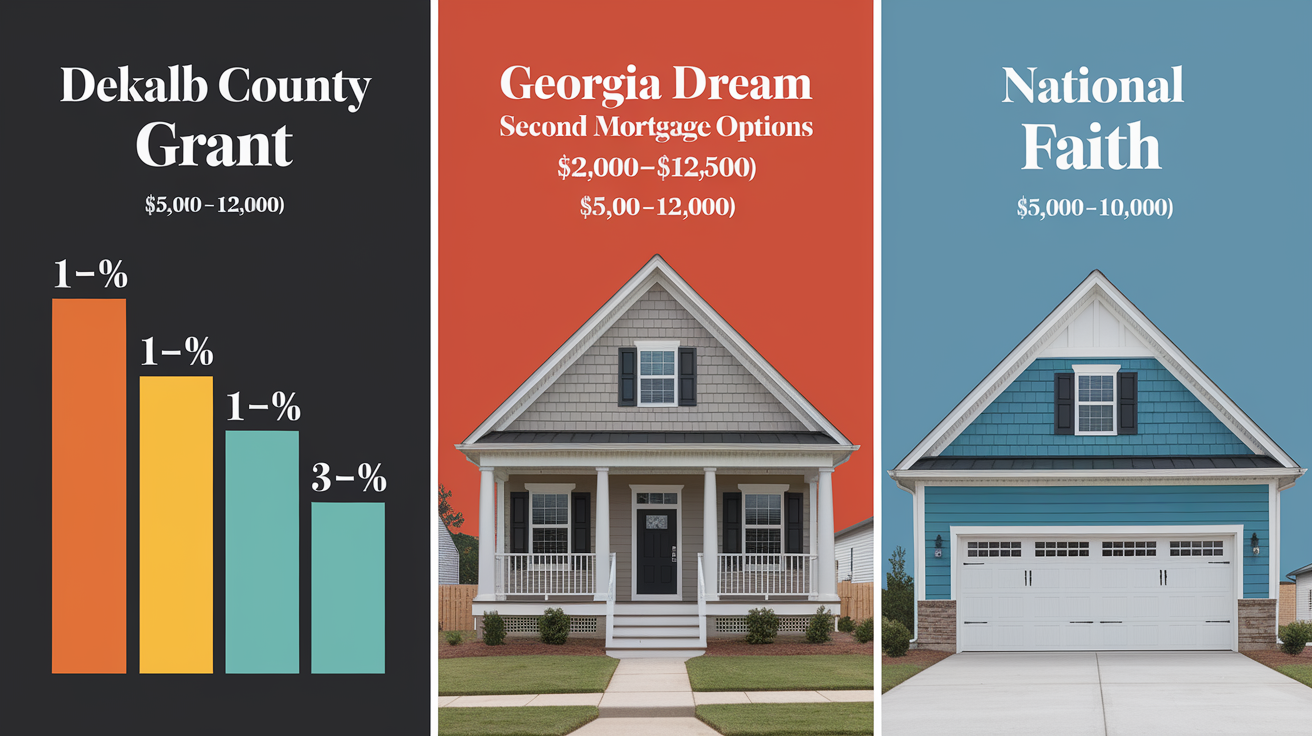
DeKalb County’s grant structure gives you 1 to 3 percent of the mortgage amount with no repayment. Georgia Dream’s deferred second mortgage model provides $10,000 to $12,500 in assistance but requires repayment when you sell or refinance. National Faith splits the difference by providing $5,000 to $10,000 that’s fully forgiven after five years of occupancy. Stay put and you avoid any repayment. Teacher Next Door offers $1,000 to $8,000 as a grant, with the possibility of an additional $10,681 in down payment and closing cost assistance for qualifying public service professionals. The entire amount is structured as a grant.
Forgiveness timelines matter most if you expect to move or refinance before the retention period ends. A five-year forgiveness window is easier to meet than a ten-year window. Buyers who know they’ll stay at least that long can treat the assistance as free money rather than a loan. Deferred loans with no forgiveness offer the largest funding amounts but require full repayment whenever you sell. That can reduce net proceeds at closing and complicate refinancing decisions if rates drop. Grant structures like DeKalb County’s program or Teacher Next Door work best if you value flexibility. There’s no repayment or occupancy requirement beyond standard mortgage terms, and the money never converts into a lien that must be satisfied before a sale or refi closes.
Required Documentation and Application Steps for DeKalb County Buyers

Here’s how the application process works for DeKalb County homebuyer assistance:
1. Contact a participating lender and request preapproval
Start with a lender who participates in the DeKalb County program and confirm they can handle both the primary mortgage and the grant application in a single process. Tell them: “I’m shopping for a home in DeKalb County and want to use the county’s down payment grant, so I need a lender who participates in that program.”
2. Gather income and asset documentation
Collect recent pay stubs, W-2s or 1099s, bank statements covering the past two months, tax returns if you’re self-employed, and any documentation of additional household income from other earners living in the home.
3. Submit a credit authorization and verify your score
Let the lender pull your credit report and verify your score meets the program’s minimum threshold. Address any credit issues or disputes before moving forward if your score falls below the required level.
4. Complete required homebuyer education course
Enroll in and finish the homebuyer education or counseling session required by the program. Get the completion certificate to submit with your application. Most courses take four to eight hours and are available online or in person.
5. Identify a property within program limits
Search for homes that meet the purchase price cap and property type requirements. Confirm the home qualifies as your primary residence under program rules before making an offer.
6. Submit the full application package to your lender
Provide all required documents: proof of income, assets, employment, education certificate, and signed purchase contract. Your lender submits both the mortgage application and the grant request to the county program administrator.
7. Undergo underwriting and appraisal
Wait for the lender to complete underwriting, order the appraisal, and verify that the property meets program standards and loan-to-value requirements. This typically takes two to four weeks once all documents are submitted.
8. Close on the mortgage and receive grant funds
Attend the closing appointment, sign loan documents, and confirm that the grant funds are applied to reduce your cash-to-close amount. Final settlement typically occurs 30 to 60 days after the application is submitted.
Timelines vary depending on the complexity of your financial profile, the lender’s workload, and whether the property appraisal or title search uncovers any issues. Georgia Dream notes that the process typically takes about 60 days from application to closing. Simpler county programs or buyers with straightforward income and credit may close in as little as 30 days. Stay in close contact with your lender throughout the process. Missing a single document or education certificate can delay approval and push back your closing date.
DeKalb County Property Eligibility and Purchase Price Limits

DeKalb County’s program doesn’t specify a maximum purchase price, but the underlying mortgage must meet standard loan qualification limits. Buyers are effectively capped by conforming loan limits (currently $806,500 in high-cost areas for a single-family home) or the specific loan product they choose. Single-family homes, condominiums, and townhouses all qualify, provided the property will serve as your primary residence and meets the lender’s appraisal and condition standards. Manufactured homes may qualify if they’re permanently affixed to a foundation and meet FHA or conventional loan requirements. Mobile homes on leased land typically don’t qualify under most assistance programs.
Statewide programs impose stricter purchase price caps that DeKalb buyers must follow if they layer additional assistance onto the county grant. Georgia Dream limits purchase prices to a range of $297,000 to $350,000 depending on the county. Atlanta Housing caps purchases at $375,000. National Faith sets a $325,000 maximum. Buyers shopping above these limits can still use the DeKalb County grant alone, but they lose access to the stacked assistance that could otherwise cover a larger portion of their down payment and closing costs. Property types remain consistent across most programs: single-family, condo, townhouse. You’ll occasionally see restrictions on investment properties, second homes, or properties requiring major repairs before closing.
Combining DeKalb County Grants With Other Assistance Programs

Many buyers combine the DeKalb County grant (1 to 3 percent of the mortgage amount) with Georgia Dream (up to $10,000 to $12,500), National Faith ($5,000 to $10,000), or Teacher Next Door ($1,000 to $8,000 plus potential $10,681 additional assistance) to cover the full down payment and most closing costs with minimal out-of-pocket cash. The stacking approach works because the DeKalb grant doesn’t require repayment, while statewide programs may require repayment or impose forgiveness timelines that don’t conflict with the county’s structure.
You’ve still got to meet the primary mortgage approval requirements. That’s 3.5 percent down for FHA, 0 percent for VA or USDA if you’re eligible, or 3 percent for conventional. The combined assistance can’t exceed the total amount needed for down payment and closing costs, so lenders calculate the stack carefully to avoid over-funding.
What to think about when combining assistance programs:
- Program compatibility: verify that each program allows stacking with other assistance, since some grants prohibit combining with certain loan types or second mortgages
- Repayment and forgiveness rules: understand which assistance requires repayment at sale or refinance and which forgives after a set period, so you can plan around potential moves or rate changes
- Total assistance caps: lenders and programs limit combined assistance to the actual amount needed for down payment and closing costs, so excess funds can’t be used for repairs, rate buydowns, or cash back
- Debt-to-income and credit impact: adding a second mortgage (even at 0 percent interest) may affect your DTI calculation and loan approval, though most deferred loans don’t require monthly payments and don’t count against DTI
- Occupancy and primary residence requirements: all stacked programs typically require the home to be your primary residence, and violating that rule on any program can trigger repayment or penalties across the entire assistance package
Final Words
DeKalb County offers a 1–3% grant to help with down payment and closing costs, and it’s not limited to only first-time buyers. The grant ties to your mortgage rate and is delivered through participating lenders, so the lender’s role matters.
You can stack this with Georgia Dream and other programs, but expect paperwork, a homebuyer course, and a 30–60 day timeline once you apply.
If you’re exploring dekalb county first-time homebuyer assistance programs, start with a lender pre-approval and take it from there — you’ve got options.
FAQ
Q: What does the DeKalb County homebuyer assistance program provide?
A: The DeKalb County homebuyer assistance program provides a grant equal to 1–3% of the principal mortgage that can help with down payment and closing costs, and it’s not limited to first-time buyers.
Q: How is the grant amount determined?
A: The grant amount is determined by your mortgage interest rate, producing a 1–3% grant of the principal mortgage amount tied to that rate and program rules.
Q: Do I have to be a first-time buyer to get DeKalb assistance?
A: You don’t have to be a first-time buyer; DeKalb’s grant is available to a broader buyer pool beyond first-time purchasers, subject to program participation rules.
Q: How do I apply for the DeKalb County grant?
A: The way to apply is through a participating lender—your lender submits the application and guides the process under the county’s lender-driven system.
Q: What mortgage type is required to use the DeKalb grant?
A: The required mortgage type is a 30-year fixed-rate mortgage issued by a participating lender to qualify for the DeKalb County grant.
Q: What statewide programs can DeKalb buyers also use?
A: DeKalb buyers can use Georgia Dream (Standard $10,000, PEN $12,500, CHOICE up to 6% of price) plus programs like National Faith and Teacher Next Door for extra aid.
Q: How do grants compare to repayable assistance like Georgia Dream?
A: Grants such as DeKalb’s require no repayment, while Georgia Dream offers $10,000–$12,500 options that are generally repayable when the property is sold or refinanced.
Q: What documents are needed to apply for assistance?
A: The documents needed to apply are lender preapproval, proof of income and household size, asset statements, employment verification, credit information, and homebuyer education certificates.
Q: How long does the application and closing process usually take?
A: The application and closing timeline typically takes about 30–60 days, with Georgia Dream closings often near 60 days after submission of complete documents.
Q: Can I combine the DeKalb grant with other assistance programs?
A: You can often combine the DeKalb 1–3% grant with programs like Georgia Dream, National Faith, or Teacher Next Door, but stacking depends on lender rules and program restrictions.
Q: What types of properties qualify and what are typical purchase price limits?
A: Qualifying properties include single-family homes, condos, townhouses, and some manufactured homes; purchase price caps vary by program (roughly $297k–$375k depending on the program).
Q: Who benefits most from grants versus deferred or forgivable loans?
A: Buyers needing immediate down payment help benefit from grants; those needing larger aid or income-targeted relief may prefer deferred or forgivable loans tied to time or occupancy requirements.
Q: Are there income, credit, or asset limits I should expect?
A: Expect program-specific limits: DeKalb’s max income is about $134,960, Georgia Dream ranges roughly $74,500–$99,500, credit minimums often 580–640, and liquid asset caps commonly apply.